


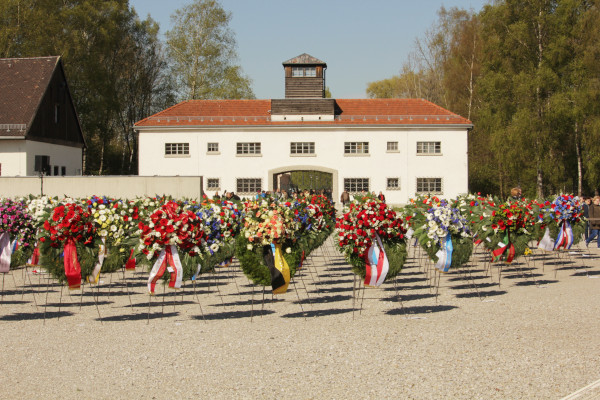
80th anniversary of the liberation
On 29 April 1945, Dachau was liberated by US troops.
The celebration of this special 80th anniversary has an extensive programme.
On 29 April 1945, Dachau was liberated by US troops.
The celebration of this special 80th anniversary has an extensive programme.
The formation of the International Brigades was a response to the international call to defend the Spanish Republic against the advance of fascism. Volunteers from all over the world, inspired by ideals of international solidarity, united to fight in support of the republican cause, remaining in Spain from October 1936 until its dissolution on September 28, 1938, shortly before the end of the Spanish Civil War in 1939. A plaque dedicated to the Austrian brigade members in the memory room of the Dachau Memorial brings us closer to the reunion between the Spanish deportees and the brigade members. That reunion provided the Spaniards with invaluable help that accompanied them during the time they were deported; the language barrier was a great handicap against their perpetrators.
As president of the Spanish Association Amical Dachau, Cristina Cristóbal established a cooperation with the "Österreichischen KZ-Gemeinschaft Dachau" to jointly hold on June 5, 2024 at the Cervantes Institute in Munich the talk-colloquium: Rotspanier And The Brigadistas International Internations: The Transmission Of Your Experience Through The Family Narrative. This event focused on sharing and transmitting the different family narratives that brought us closer to the lives of three deportees to Dachau: Ferdinand Berger, Alois Peter and Fermín Cristóbal. Three lives with a parallel story that began in the Spanish War and ended with his deportation to Dachau.
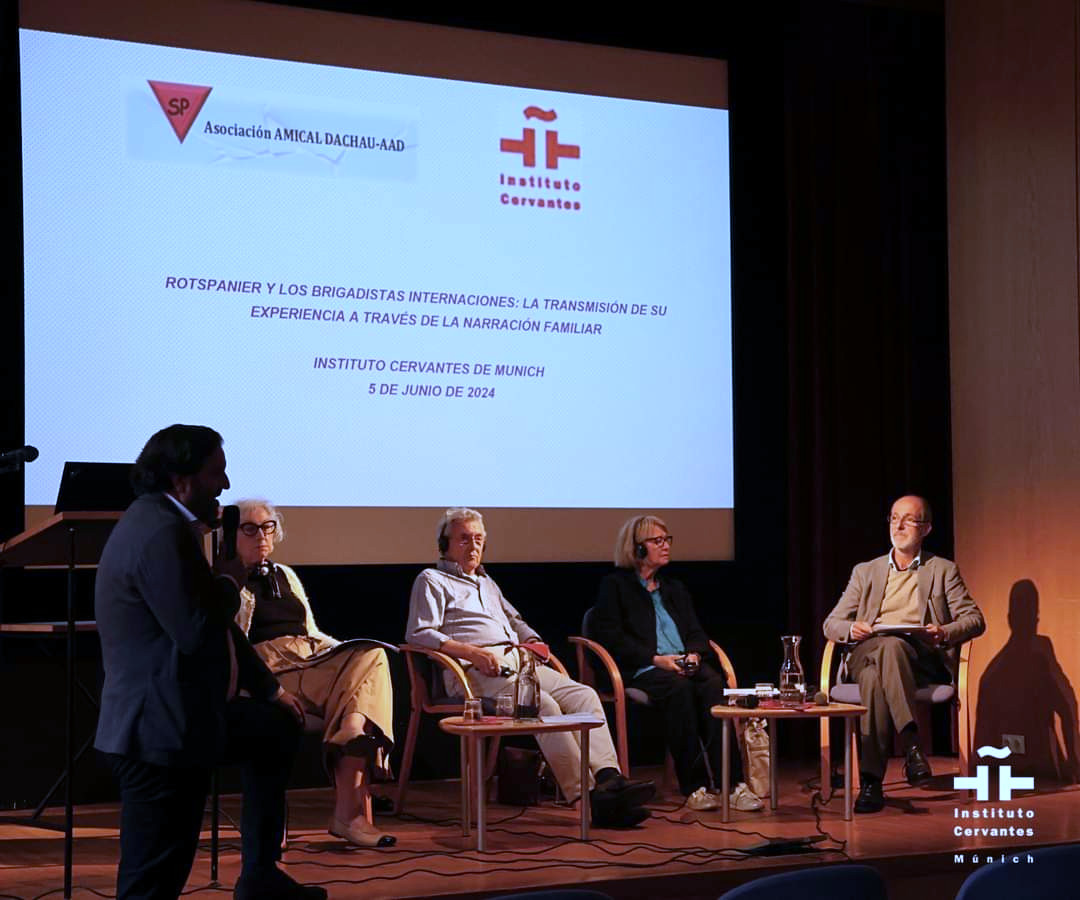 Felipe Santos,Cristina Cristóbal, Ernst berger, Eva Friedler, Carlos Collado Seidel Photo: Cervantes Institute Munich (2024)
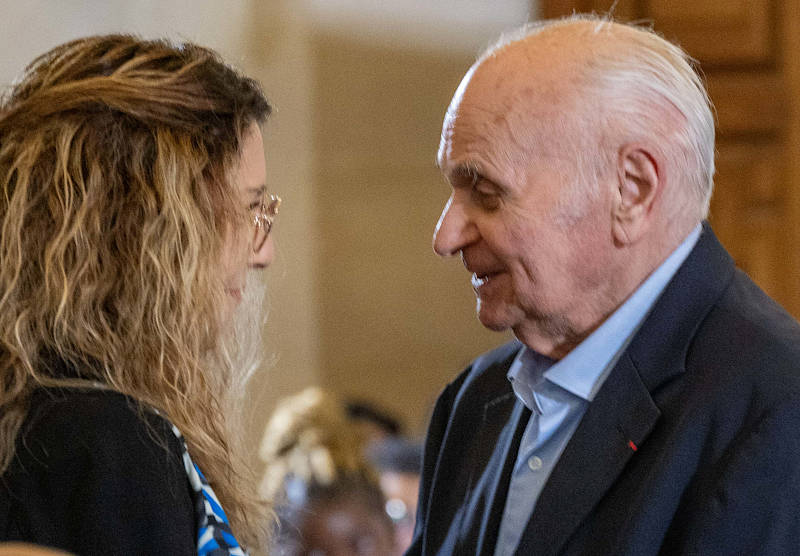 Pierre Schillio in the presence of Patricia Mirallès, Secretary of State to the Minister for the Armed Forces, with responsibility for Veterans and Remembrance, at the ceremony to officialise the Union of Nazi Camp Remembrance Associations, on 3 October 2023.
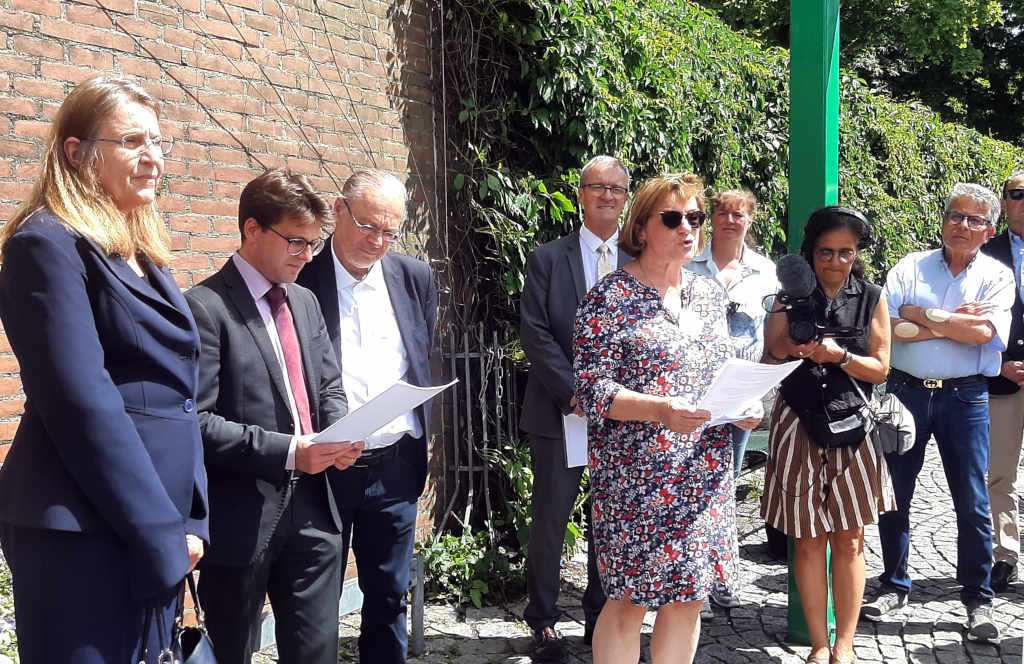
 V.l.t.R. Mayor of Dachau Florian Hartmann, CID President Dominique Boueilh, Award winner Josch Döpp M.A., Prof. Dr. Sybille Steinbacher, Dr. Gabriele Hammermann
On the occasion of the awarding of the Stanislav Zámečník Study Prize for 2024, the President of the CID Dominique Boueilh, Secretary General Cristina Cristóbal, Dr. Ernst Berger, Prof. Dr. Sybille Steinbacher, Dr. Gabi Hammermann, Florian Hartmann, mayor of the city of Dachau, members of the CID and other invited guests met in the plenary hall of the New Dachau Town Hall to present the Stanislav Zámečník Study Prize for 2024.
 © Comité International de Dachau
Some of the carriages gradually become mass graves, where people die from heat, lack of water, asphyxiation, or from the blows of their neighbours fighting for their own survival.
From 2 to 5 July 2024, the Amicale française du camp de concentration de Dachau (French association of the Dachau concentration camp) made a 4-day commemorative journey with a group made up of the families of victims or survivors of deportee convoy 7909, which left Compiègne on 2 July 1944 with more than 2,000 men on board, claiming more than 550 victims during the journey.

See photos of last May's celebrations here.

Sunday. 5. Mai 2024,
Today, as every year, we have gathered at the crematorium to commemorate the victims of the Dachau concentration camp. First and foremost, I would like to express my thanks and respect to the survivors present who, at an advanced age, took on the arduous journey to come to Dachau for today's liberation ceremony.

Speech by Marine Charbonneau, at the memorial for the victims of the death march, 4 May 2024
Good evening. Thank you all for coming here today to the memorial for the victims of the death march.
My name is Marine Charbonneau, I'm from France and I'm here for a year as a volunteer with Aktion Sühnezeichen Friedensdienste at the Protestant Church of Reconciliation at the Dachau Concentration Camp Memorial.
When I arrived here in September 2023, I already had a good knowledge of the history of National Socialism and the German occupation of my home country. But eight months of voluntary service changed my perspective. From now on, my focus is on the future, on future generations. History lessons alone are not enough The memorial book project for the prisoners of the Dachau concentration camp made me realise this need to teach young people more than just historical facts in order to understand the events; you have to link them to the present and the future in order to prevent the same atrocities from happening again, in whatever form.

AT THE BORDER AGAIN
Speech on the 79th anniversary of the liberation of Dachau concentration camp
Hebertshausen shooting range 4 May 2024
The plow follows a straight line. Like knives, the blades cut through the black mossy earth and throw it into loose clods. White stones lie in it. Crows swoop down on the freshly thrown up earth and peck at it. The boy has been driving the tractor for hours, row by row, up and down, lost in thought. Over at the edge of the field there is nothing but undergrowth, brambles and wild birch trees. The border to this wilderness is marked by a dead straight row of tall concrete pillars. Some of them are broken off, rusted iron protruding from the demolition sites. They stand mysteriously and menacingly in the wilderness. Remnants of barbed wire hang from them. A paper sack is caught on them and whines in the wind. The adults have told the boy that the land behind the posts once belonged to his grandfather.

Speech Carlotta Seidel ,Hebertshausen shooting range 4 May 2024
I have been doing a voluntary social year at the Max Mannheimer Study Centre in Dachau since September. When I started working there, I realised how little I had actually learned about National Socialism at school. There are many topics that were not even addressed. For example, that Soviet prisoners of war were taken to various concentration camps to be murdered there directly. That these people were never registered in the concentration camps. That only a few names are known to this day.
